What Is Payment Packing? The #1 Trick Dealers Use to Steal Your Money
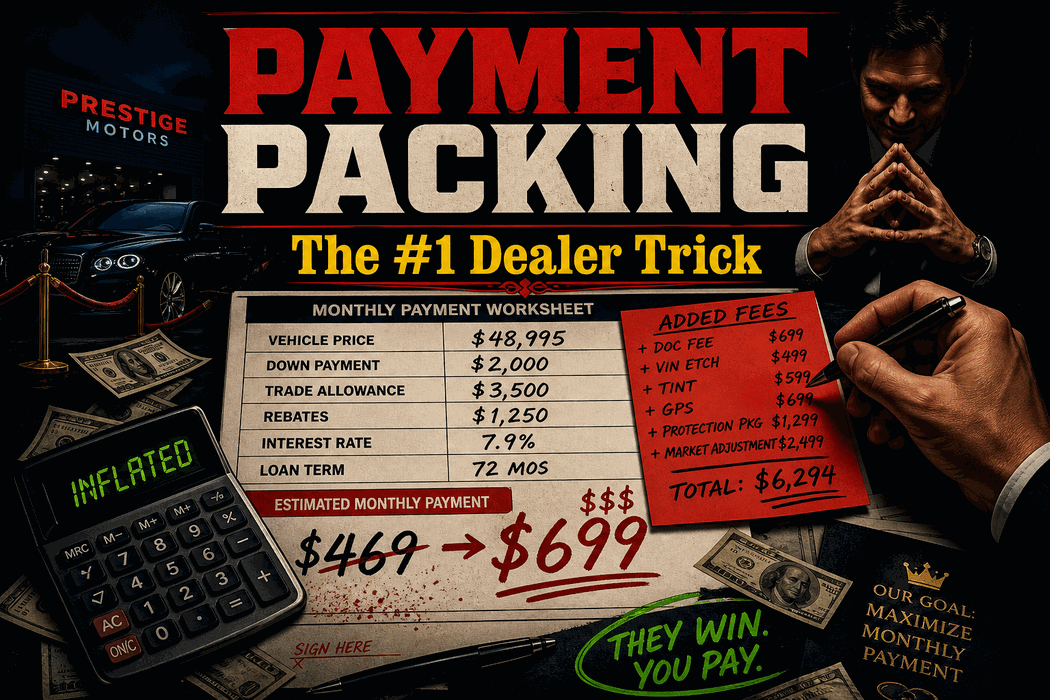
Table of Contents
What Is Payment Packing?
Payment packing is when a dealer quotes you a monthly payment that's higher than it should be — then uses the extra money to build in hidden profit.
Here's how it works:
- You agree on a vehicle price
- Your credit is approved at, say, 5.9% APR
- The finance manager tells you: "Great news — we got you approved at $485/month!"
- But if you do the math, the real payment at 5.9% should be $440/month
- That extra $45/month × 72 months = $3,240 in hidden profit
The $3,240 disappears into one or more of:
- An inflated APR (the dealer keeps the spread as a "reserve")
- A warranty or protection product you never explicitly agreed to
- A GAP insurance policy buried in the paperwork
- Pure dealer profit added to the loan amount
How Common Is Payment Packing?
Extremely common. A 2024 Consumer Financial Protection Bureau (CFPB) report found that dealers add an average of $1,100–$1,800 in markup to consumer auto loans. On subprime loans, that number jumps to $2,500+.
The reason it persists: most buyers never check the math. They focus on whether the monthly payment "fits their budget" — not whether it's mathematically correct.
A Real Example
Let's say you're buying a car:
| Item | Amount |
|---|---|
| Vehicle price | $32,000 |
| Trade-in | -$4,000 |
| Down payment | -$1,000 |
| Tax + fees | +$2,800 |
| Loan amount | $29,800 |
At 5.9% APR for 72 months, the correct monthly payment is: $506
But the dealer tells you: "Your payment is $558/month."
That $52/month difference over 72 months = $3,744 in hidden profit.
Where did the money go? Check the contract — there's probably:
- An extended warranty ($2,200) you didn't realize was added
- GAP insurance ($800) you didn't ask for
- A "tire and wheel" package ($744) buried on page 3
How to Detect Payment Packing
Method 1: Do the Math Yourself
Use this simple formula:
Monthly Payment = Loan Amount × (r × (1+r)^n) / ((1+r)^n - 1)
Where:
- r = monthly interest rate (APR ÷ 12 ÷ 100)
- n = total number of payments
Or skip the algebra and use DealerMath Decoder — paste the dealer's numbers and it will:
- Back-solve the real APR
- Flag if the payment is higher than it should be
- Calculate exactly how much extra you're paying
Method 2: Compare APR to Your Pre-Approval
If your credit union pre-approved you at 5.4% but the dealer is presenting a payment based on 7.9%, the 2.5% spread is profit they're keeping.
Method 3: Ask One Simple Question
"Can you show me the payment breakdown — the exact loan amount, APR, and term that produce this monthly number?"
If the finance manager hesitates, deflects, or says "that's just how the system calculates it" — the payment is packed.
How to Protect Yourself
Before the Dealership
- Get pre-approved financing — know your rate BEFORE you walk in
- Calculate your expected payment using an online calculator or DealerMath Decoder
- Write down your numbers — loan amount, APR, term, and expected payment
At the Dealership
- Ask for an itemized breakdown of the monthly payment
- Compare the dealer's APR to your pre-approval
- Decline all add-ons in the F&I office unless you specifically want them
- Read every page of the contract before signing
After Signing (If You Catch It Late)
- Cancel add-on products within the cancellation window (usually 30–60 days)
- File a complaint with your state attorney general if the APR was misrepresented
- Refinance with your credit union to get the correct rate
The Bottom Line
Payment packing works because dealers quote you a single monthly number and hope you never check the math behind it.
The fix is simple: always check the math.
Decode your deal now → and see if your payment adds up.