How Dealers Lowball Your Trade-In (And the 5 Tricks They Use)
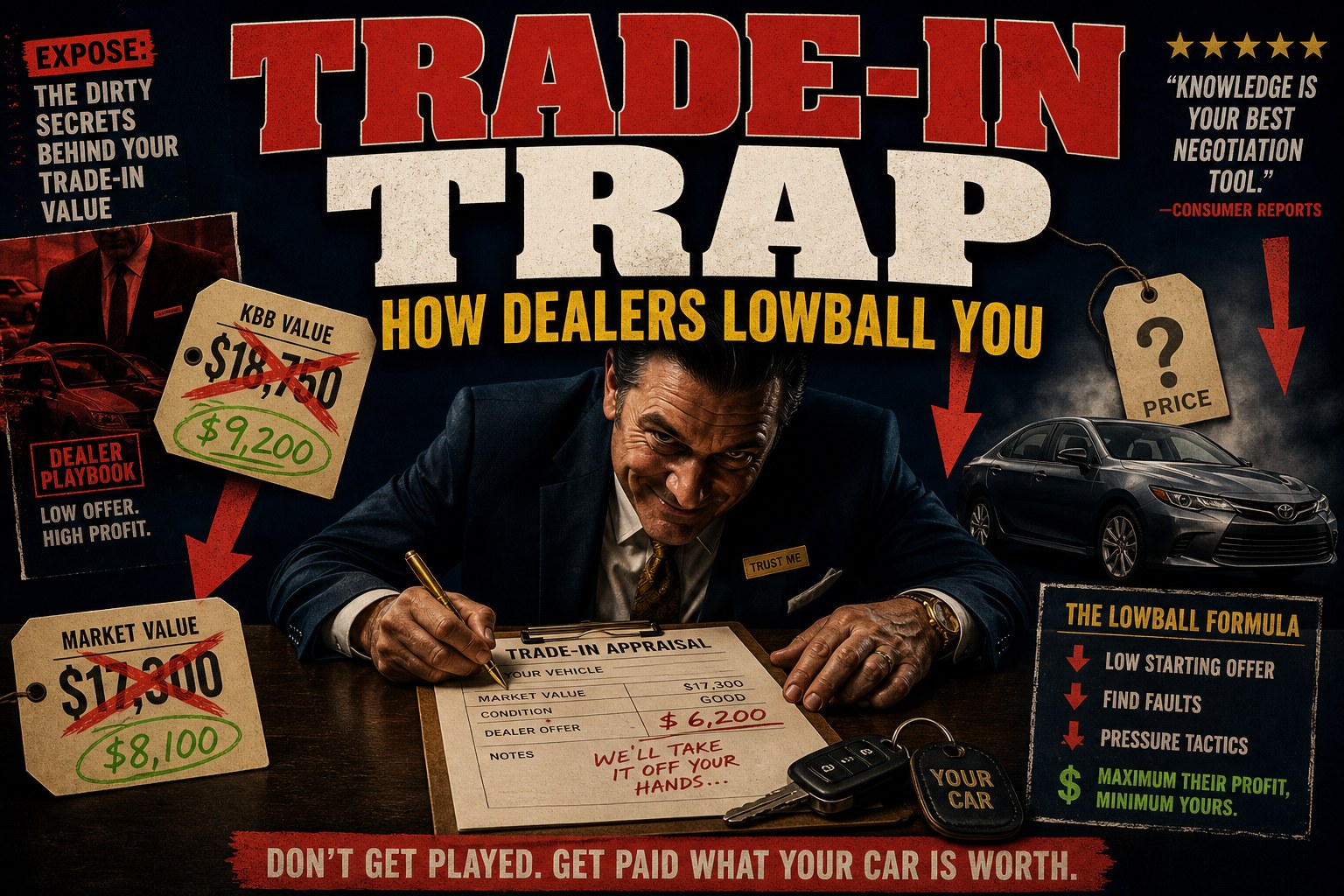
Table of Contents
How Dealers Lowball Your Trade-In
Your trade-in is the single biggest blind spot in a car deal — and dealers know it.
While most buyers obsess over vehicle price and monthly payments, the trade-in is quietly manipulated behind the scenes. The average dealer makes $2,000–$5,000 in hidden profit on trade-ins alone, according to industry data from NADA and Edmunds.
Here's why: the dealer buys your car at one price, then either resells it on their lot for more, or flips it at auction. The wider the gap between what they pay you and what they sell it for, the bigger their profit. Your loss is their gain — literally.
The 5 Trade-In Lowball Tricks
Trick #1: "The Market Is Soft Right Now"
The dealer tells you that used car prices have dropped, inventory is high, or your specific model isn't selling. This creates urgency and doubt — making you question your own research.
The truth: Used car values are transparent. Check KBB, Edmunds, and NADA Guides before you walk in. If the dealer's offer is more than 10% below the "fair purchase price" range, they're lowballing you.
Counter-move: Pull up three trade-in value estimates on your phone and say: "I've got KBB at $18,500, Edmunds at $18,200, and NADA at $19,100. Where are you getting your number?"
Trick #2: The Walkaround Nitpick
A manager walks around your car pointing out every scratch, ding, tire wear mark, and "concern." They might even squat down and peer under the car dramatically. This is theater — designed to make you feel your car is worth less than you thought.
The truth: Minor cosmetic wear is already factored into "Good" or "Fair" condition estimates on KBB. Unless your car has structural damage or mechanical issues, these nitpicks shouldn't drop the price by thousands.
Counter-move: "I appreciate the inspection, but this is normal wear for a car with [X] miles. My KBB 'Good Condition' estimate already accounts for that."
Trick #3: The Delayed Appraisal
The dealer takes your keys "to have the shop look at it" and disappears for 30–45 minutes. This is intentional. They want you invested (emotionally and time-wise) in the new car before revealing a lowball trade-in number.
The truth: A trade-in appraisal takes 10 minutes. The rest is negotiation strategy — they're letting you fall in love with the new car while your leverage evaporates.
Counter-move: Get your trade-in number first, before test-driving or discussing the new car. Say: "Let's handle the trade-in first. Can you appraise it while I wait?"
Trick #4: Bundling Trade-In with the New Car Price
This is the most dangerous trick. The dealer offers you a great price on the new car but quietly lowers the trade-in — or vice versa. On the 4-square worksheet, the numbers bounce between boxes, and you can't tell where the profit is hiding.
Example:
- Vehicle price: $35,000 → Lowered to $33,500 ✅ (feels like a win)
- Trade-in: $18,000 → Lowered to $15,000 ❌ (you just lost $3,000)
- Net cost to you: Actually $1,500 higher than the original deal
Counter-move: Negotiate the trade-in and new car price as separate transactions. Never let them bundle numbers. Ask: "What's the out-the-door price WITHOUT my trade-in?" Then negotiate the trade-in independently.
Trick #5: "We'll Match Any Offer" (But They Won't)
Some dealers promise to match or beat any trade-in offer. When you bring in a Carvana or CarMax quote, they'll find reasons to discredit it: "That's an online estimate — it'll change after inspection," or "Those companies don't pay that once they see the car."
The truth: Carvana, CarMax, and Vroom quotes are usually locked in for 7 days. If the dealer won't match a real written offer, that tells you everything about their trade-in margins.
Counter-move: Get a written offer from CarMax or Carvana before visiting the dealer. Use it as a floor. If the dealer won't match it, sell your trade-in separately.
What Your Trade-In Is Actually Worth
Before stepping into a dealership, check these three sources:
| Source | URL | What It Tells You |
|---|---|---|
| KBB | kbb.com | Retail value, trade-in range, private party |
| Edmunds | edmunds.com | TMV (True Market Value) appraisal |
| NADA Guides | nadaguides.com | Dealer-used wholesale values |
The trade-in value is what a dealer should pay you. The private party value is what you'd get selling it yourself (usually 15–20% higher). If a dealer offers you less than the low end of KBB trade-in, they're lowballing.
The Nuclear Option: Sell Your Car Separately
If the dealer won't give you a fair trade-in, you always have the option to sell your car privately or to an online buyer:
- CarMax — Walk in, get a written offer in 30 minutes, valid for 7 days
- Carvana — Online offer in 2 minutes, they pick up the car
- Facebook Marketplace — Higher prices but requires more effort
- Private sale — Highest value, most work
Selling separately is more hassle, but it typically nets you $2,000–$4,000 more than a dealer trade-in.
How DealerMath Decoder Helps
When you paste a dealer worksheet into DealerMath Decoder, we automatically flag trade-in discrepancies. If the trade-in value looks suspiciously low compared to market data, you'll see a red flag with the estimated cost impact — so you know exactly how much money is at stake before you sign anything.
The Bottom Line
Your trade-in is worth more than the dealer says. Always:
- ✅ Get three independent estimates before visiting the dealer
- ✅ Negotiate trade-in and vehicle price separately
- ✅ Get a written offer from CarMax or Carvana as leverage
- ✅ Never hand over your keys before getting a trade-in number
- ✅ Use DealerMath Decoder to verify the math on any worksheet
Don't let the trade-in be the silent profit center that costs you thousands.