Dealer Invoice vs. MSRP: What the Dealer Really Paid (And What You Should Pay)
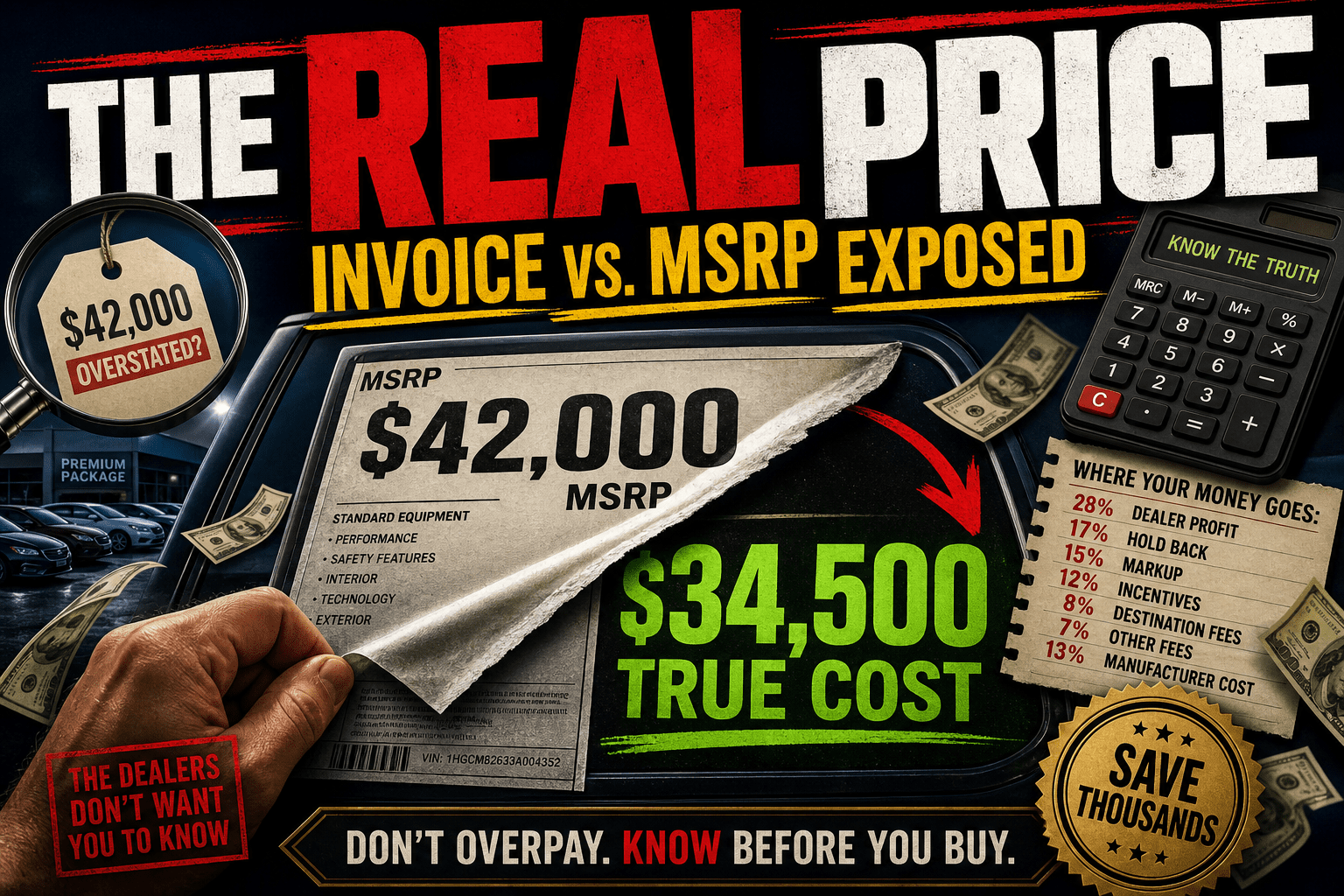
Table of Contents
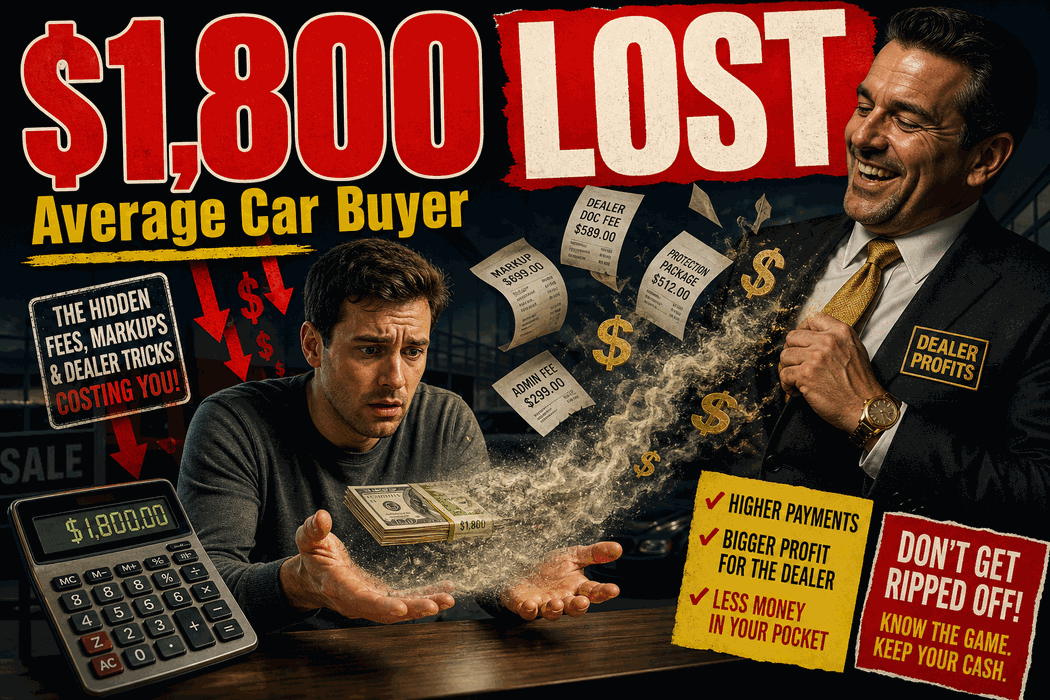
The Price Tag Is a Lie
Every car on a dealer lot has a Monroney sticker on the window showing the MSRP (Manufacturer's Suggested Retail Price). Most buyers treat this number as the "real price" and try to negotiate down from there.
But the MSRP is just the ceiling — it's the maximum the manufacturer thinks a dealer can charge. The actual cost to the dealer is significantly lower, and understanding that gap is the key to negotiating like a pro.
The Three Prices You Need to Know
1. MSRP (Sticker Price)
What it is: The manufacturer's suggested retail price, printed on the window sticker.
What it means: This is the starting point for negotiation — never the ending point. Think of it as the "hope price" — what the dealer hopes you'll pay.
Example: A 2026 Toyota RAV4 XLE has an MSRP of $33,275.
2. Dealer Invoice Price
What it is: The price the dealer supposedly paid the manufacturer for the car.
What it means: This sounds like the dealer's true cost, but it's not. The invoice price is typically 3–8% below MSRP, and it's the number dealers will reluctantly show you to "prove" they're making no money.
Example: That same RAV4 has a dealer invoice of approximately $31,100 — about $2,175 below MSRP.
The catch: The invoice is NOT the dealer's real cost. There are hidden profit sources below invoice.
3. True Dealer Cost (The Real Number)
What it is: The actual amount the dealer pays after all hidden incentives, holdback, and rebates.
True dealer cost = Invoice − Holdback − Dealer Incentives − Volume Bonuses
Example: That RAV4's true dealer cost might be closer to $29,500–$30,200 — meaning the dealer has $3,000–$3,775 in margin even at "invoice price."
The Hidden Profit Sources
Holdback (2–3% of MSRP)
What it is: A percentage of MSRP (typically 2–3%) that the manufacturer pays back to the dealer after the car is sold. It's essentially a guaranteed profit cushion that doesn't appear on any paperwork you'll see.
| Brand | Holdback | On a $35,000 Car |
|---|---|---|
| Toyota | 2% of invoice | ~$620 |
| Honda | 2% of MSRP | ~$700 |
| Ford | 3% of MSRP | ~$1,050 |
| Chevy | 3% of MSRP | ~$1,050 |
| Hyundai | 3% of invoice | ~$960 |
| BMW | None | $0 |
| Mercedes | 1% of MSRP | ~$350 |
Why it matters: When a dealer tells you they're "selling at invoice and making nothing," they're still pocketing the holdback — $600–$1,050 on most cars.
Dealer Cash / Incentives
What it is: Cash bonuses from the manufacturer to the dealer, intended to move specific models. These are not passed on to you unless you know to ask.
Example: Ford might offer dealers $1,500 cash on slow-selling Escapes. The dealer pockets this on top of whatever price you negotiate.
How to find them: Check Edmunds.com, CarsDirect, or TrueCar for current dealer incentive information by model.
Volume Bonuses
What it is: Quarterly or annual bonuses paid to dealers who hit sales volume targets. A dealer approaching their target may discount cars aggressively to earn a $50,000–$200,000 bonus.
When to exploit this: End of quarter (March, June, September, December) and especially end of year. Dealers will lose money on individual deals to hit volume targets worth far more.
Floorplan Assistance
What it is: Manufacturers often subsidize the interest dealers pay to keep cars on their lot ("floorplan costs"). Some manufacturers reimburse floorplan interest entirely — another hidden benefit that reduces the dealer's true cost.
What Should You Actually Pay?
Here's a realistic target framework based on market conditions:
Normal Market (Balanced Supply/Demand)
| Category | Target Price |
|---|---|
| High-demand car (Civic, RAV4, etc.) | Invoice to MSRP |
| Average-demand car | 2–4% below invoice |
| Slow-selling car | 5–8% below invoice |
| Year-end leftover | 8–12% below invoice |
Buyer's Market (High Inventory)
| Category | Target Price |
|---|---|
| High-demand car | Invoice − holdback |
| Average car | 4–6% below invoice |
| Slow-seller | 8–15% below invoice |
Seller's Market (Low Inventory, High Demand)
| Category | Target Price |
|---|---|
| Any car | MSRP is the ceiling — refuse "market adjustments" |
| High-demand | MSRP or walk |
The "Below Invoice" Myth
Dealers love to advertise "below invoice pricing!" to make you feel like you're getting a steal. Now you know the truth: even "below invoice," the dealer is still making money from:
- ✅ Holdback ($600–$1,050)
- ✅ Dealer cash incentives ($500–$2,000)
- ✅ Volume bonuses (allocated per unit)
- ✅ F&I office profit ($2,000–$3,500 average)
- ✅ Trade-in profit ($2,000–$5,000)
A dealer selling a car "$500 below invoice" is still pocketing $5,000–$12,000 when you add up all profit centers. "Below invoice" is marketing, not charity.
How to Research the Real Numbers
Step 1: Find Invoice Price
- Edmunds.com — Most accurate invoice data, includes destination charges
- TrueCar — Shows what others in your area paid
- KBB.com — Fair purchase price range
Step 2: Estimate Holdback
- Search "[brand] dealer holdback percentage" — the numbers are publicly known
- Subtract holdback from invoice for a closer approximation of true cost
Step 3: Check Current Incentives
- Edmunds Incentives & Rebates page — updated monthly
- Manufacturer website — current offers section
- CarsDirect — dealer incentive tracker
Step 4: Calculate Your Target
Your target = Invoice − Holdback − Available Incentives + Fair Dealer Profit ($300–$500)
Yes, dealers deserve to make a profit. Targeting a $300–$500 margin over true cost is fair and realistic — and still saves you thousands compared to paying MSRP.
The Negotiation Script
Armed with these numbers, here's your approach:
"I've done my research. The invoice on this car is $31,100, and I know there's about $620 in holdback plus current dealer incentives. I'm prepared to offer $30,800 out the door, which gives you a fair margin on the deal. I have financing arranged through my credit union. Can we make this work?"
This script works because:
- It signals knowledge — the dealer knows you understand the real numbers
- It anchors low but fairly — you're not insulting them
- It removes financing profit — pre-arranged financing means no APR markup
- It says "out the door" — preventing fee-stuffing after the price is agreed
How DealerMath Decoder Helps
When you paste a dealer worksheet into DealerMath Decoder, we compare the vehicle price against known invoice and MSRP ranges. If the price is at or above MSRP, you'll see a flag showing exactly how much room there is to negotiate — and the estimated true dealer cost so you know where the floor really is.
The Bottom Line
Every car has three prices: MSRP (the ceiling), invoice (the middle), and true dealer cost (the floor). Most buyers negotiate between MSRP and invoice — but the real savings are below invoice, in the gap between the invoice price and the dealer's true cost.
- ✅ Never start from MSRP — always research invoice first
- ✅ Subtract holdback (2–3%) to estimate true dealer cost
- ✅ Check current dealer incentives on Edmunds/CarsDirect
- ✅ Target invoice minus holdback plus a $300–$500 fair profit
- ✅ Always negotiate the out-the-door price — not monthly payments
- ✅ Use DealerMath Decoder to verify the math on any worksheet